
IDEXX Cancer Dx testing
Resources

Learn more about veterinary oncology.
Access a curated collection of education at the IDEXX Learning Centre, including webinars, news, links to industry resources and more.
Visit nowDownloadable medical resources.
Having the medical materials at hand makes it easy for your practice to have the information you need, when you need it. Here, you’ll find links to the IDEXX Cancer Dx testing clinical reference guide, white paper, algorithm and case study.
Clinical reference guide
An easy, convenient way to learn about cancer prevalence, risk factors, how to use IDEXX Cancer Dx testing and more.
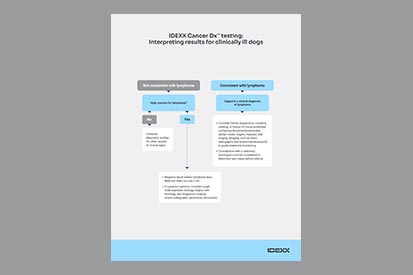
Algorithm
Everything you need to know to get started and up to speed on IDEXX Cancer Dx testing.
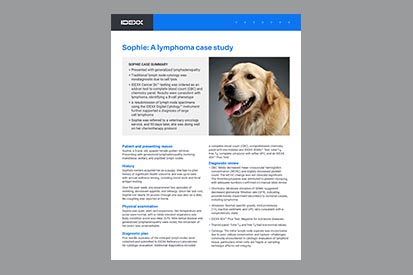
Case study
Read this case study on Sophie, a 5-year-old golden retriever whose IDEXX Cancer Dx testing results were consistent with lymphoma.
Lymphoma resources on The Vetiverse

How to Talk to Pet Owners About Cancer Including Top Questions to Answer

Dog Breeds and Cancer: Which Dogs Have Increased Risk?
FAQs
IDEXX Cancer Dx testing provides accurate detection of biomarkers specific for lymphoma in canine serum and whole blood. B-cell vs. T-cell phenotype classification will be provided with positive results as available at no additional cost.
IDEXX Cancer Dx testing provides three indications, both for canine lymphoma:
- Aid in diagnosis: IDEXX Cancer Dx testing can be performed on dogs in which lymphoma is suspected, whether that be due to a physical examination abnormality, blood work abnormality, report of illness or change in behaviour at home.
- Screening: In early studies, IDEXX Cancer Dx testing has the potential to detect lymphoma up to 6–8 months in advance of the onset of clinical signs.¹ This would be most appropriately used in senior dogs (aged 7 years and older) and at-risk breeds aged 4 and older.
- Monitoring: In patients with a positive IDEXX Cancer Dx testing result at diagnosis (pretreatment), repeated testing can be used to monitor remission during CHOP chemotherapy.
At-risk dogs include dogs of all breeds aged 7 or older and dogs of breeds at increased risk for cancer aged 4 or older. In Australia, these dog breeds have an increased risk for lymphoma: Airedale terrier, Australian cattle dog, basset hound, beagle, border collie, boxer, bull terrier, bulldog, bullmastiff, Chesapeake Bay retriever, cocker spaniel, Dandie Dinmont terrier, dogue de Bordeaux, flat-coated retriever, foxhound, golden retriever, Gordon setter, Great Dane, Hungarian vizsla, Labrador retriever, mastiff, Neapolitan mastiff, Rhodesian ridgeback, rottweiler, schnauzer (giant), Scottish terrier, Shetland sheepdog, Saint Bernard, Welsh corgi and whippet.2
The specimen requirement for the IDEXX Cancer Dx testing is 2 mL of serum and 1 mL of EDTA whole blood (LTT) when run as a stand-alone, add-on or in a profile. When included in a profile with chemistry and CBC, IDEXX Cancer Dx testing is run using a portion of the 2 mL serum and 1 mL EDTA whole blood specimens required for standard biochemistry and haematology testing. A separate pair of tubes are not necessary.
Results will be reported as either ‘consistent with lymphoma’ or ‘not consistent with lymphoma’. If a result is unable to be obtained on the specimen submitted, the customer will be notified appropriately within their results view.
References
- Data on file at IDEXX Laboratories, Inc. Westbrook, Maine USA: Data based on testing performed at IDEXX Reference Laboratories in North America between November 1, 2024, and December 6, 2024. Analysis Report: IDEXX Cancer Dx Validation, 100282 [008_CancerDx-Validation-Report-2.Rmd].
- Bennett PF, Taylor R, Williamson P. Demographic risk factors for lymphoma in Australian dogs: 6201 cases. J Vet Intern Med. 2018;32(6):2054–2060. doi:10.1111/jvim.15306